
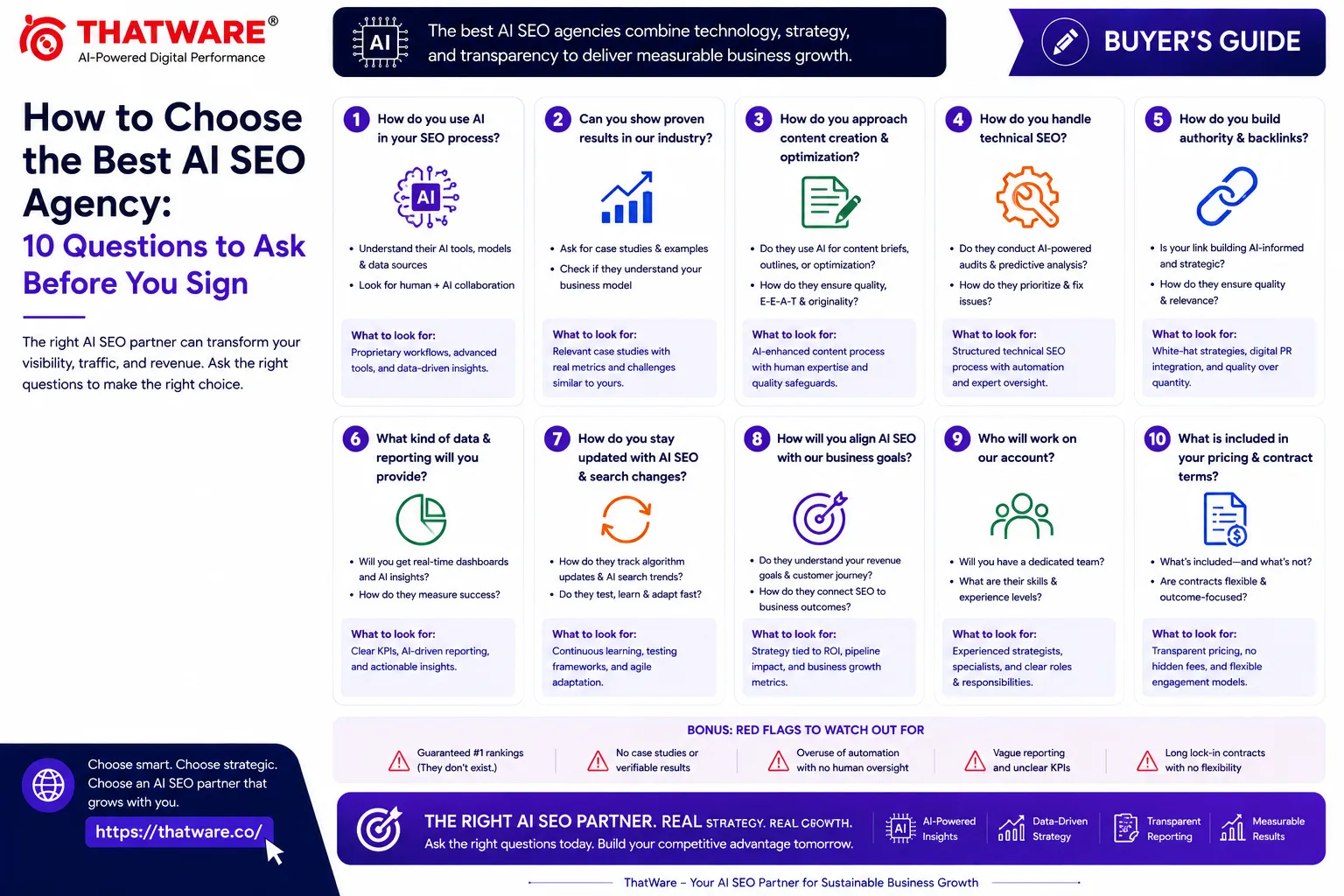
Choosing an SEO agency is always difficult. The industry has an unusual combination of high stakes, delayed feedback loops, and information asymmetry that makes it hard to evaluate quality before you’ve already committed. With AI SEO agencies specifically, there’s an additional layer of complexity: the terminology is new, the methodologies vary enormously, and the gap between agencies genuinely using ML-powered approaches and those using “AI” as a marketing label is wide.
These ten questions won’t guarantee you find the right partner. But they’ll help you quickly separate the serious practitioners from those coasting on buzzwords.
1. What specifically does your AI tooling do that off-the-shelf SEO tools don’t?
This is the most important question and the one most agencies handle poorly. Vague answers about “leveraging AI for better insights” or “using machine learning across our workflow” are red flags. Strong answers should describe specific capabilities: predictive ranking models built on their own data, custom semantic analysis systems, ML-powered technical triage with impact scoring, behavioral data integration. If they can’t describe the actual mechanics, the AI layer probably doesn’t exist.
2. How do you prioritize technical recommendations?
The answer reveals whether they’re using AI for prioritization or just running standard crawl tools. AI-informed prioritization ranks technical fixes by projected ranking impact based on modeling, not just severity categories. If the answer is “we fix critical errors first, then warnings,” they’re doing standard technical SEO regardless of what they call it.
3. Can you walk me through how a content brief gets created?
Strong answer: semantic analysis of the topic space, entity mapping, competitor gap analysis, intent variant identification, depth level specification. Weak answer: keyword research plus competitor article review. The difference reveals whether content strategy is AI-informed or manually assembled.
4. What does your reporting show during months one through three, when rankings haven’t moved much yet?
Best AI SEO agency candidates should have a clear answer about leading indicators — crawlability improvements, indexation health, content quality scores, semantic coverage progress — that demonstrate the program is building the foundation for ranking performance before that performance is visible in rank trackers. Agencies that can only point to rankings are going to have a rough first quarter with every client.
5. How do you handle algorithm updates?
The answer should describe both proactive and reactive approaches: how the methodology reduces vulnerability to updates by building genuine semantic authority, and how the monitoring and diagnosis systems enable faster response when updates do cause ranking disruption. “We watch closely and adjust” isn’t a methodology — it’s just awareness.
6. What does your client retention rate look like, and why do clients typically leave?
Honest answers here are highly revealing. High retention with specific, common reasons for departure (“they hit their growth goals and scaled internal teams” or “budget constraints when funding rounds changed”) is a good sign. Evasive answers or implausible claims of near-perfect retention are warning signs.
7. How do you measure topical authority progress?
Semantic coverage scores, entity relationship mapping, competitive position across topic clusters — these are the kinds of metrics that demonstrate topical authority progress. If the agency only measures individual keyword rankings, they’re not tracking what actually drives sustainable organic growth.
8. What’s your approach to EEAT for our specific vertical?
EEAT requirements vary by industry. Healthcare, finance, legal — these verticals have specific EEAT needs that generic SEO approaches handle poorly. An agency that gives a generic EEAT answer without acknowledging the specific requirements of your industry either doesn’t understand EEAT deeply or hasn’t thought about your context yet.
9. Can you share case studies from similar companies to ours?
Not just traffic graphs — the methodology story matters. What was the starting point, what specific approaches were taken, what results were achieved, and over what timeframe? Case studies that describe only positive outcomes without explaining the approach are essentially useless for evaluation. Hire AI SEO expert relationships that last are built on methodology transparency from the start.
10. What do you need from us to be successful?
The answer reveals whether they’ve thought seriously about the client-side requirements of their methodology. Good AI SEO programs require client input: subject matter expertise for content, development resources for technical implementation, leadership alignment on realistic timelines. Agencies that say they just need access and will handle everything are oversimplifying. The work is genuinely collaborative, and the best agencies are upfront about that.
None of these questions have trick answers. They’re designed to create space for honest, detailed responses from agencies doing sophisticated work — and to reveal the gap quickly when that sophistication isn’t there.